Party Wall Agreement Template
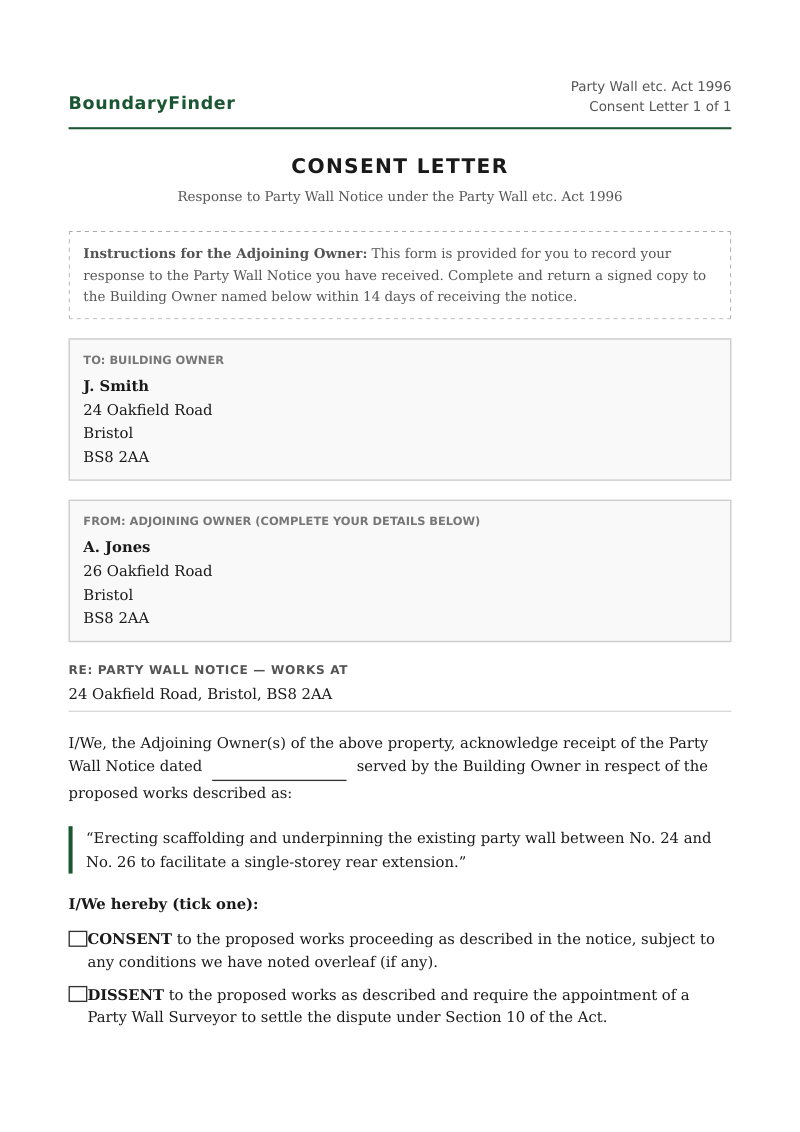
Planning a party wall notice loft conversion, rear extension, or digging close to a shared wall or boundary? Our party wall template generates your notice and consent letter instantly as a PDF.
Party Wall Agreement Template — Notice & Consent Letter — £34.95
Our party wall template — everything included
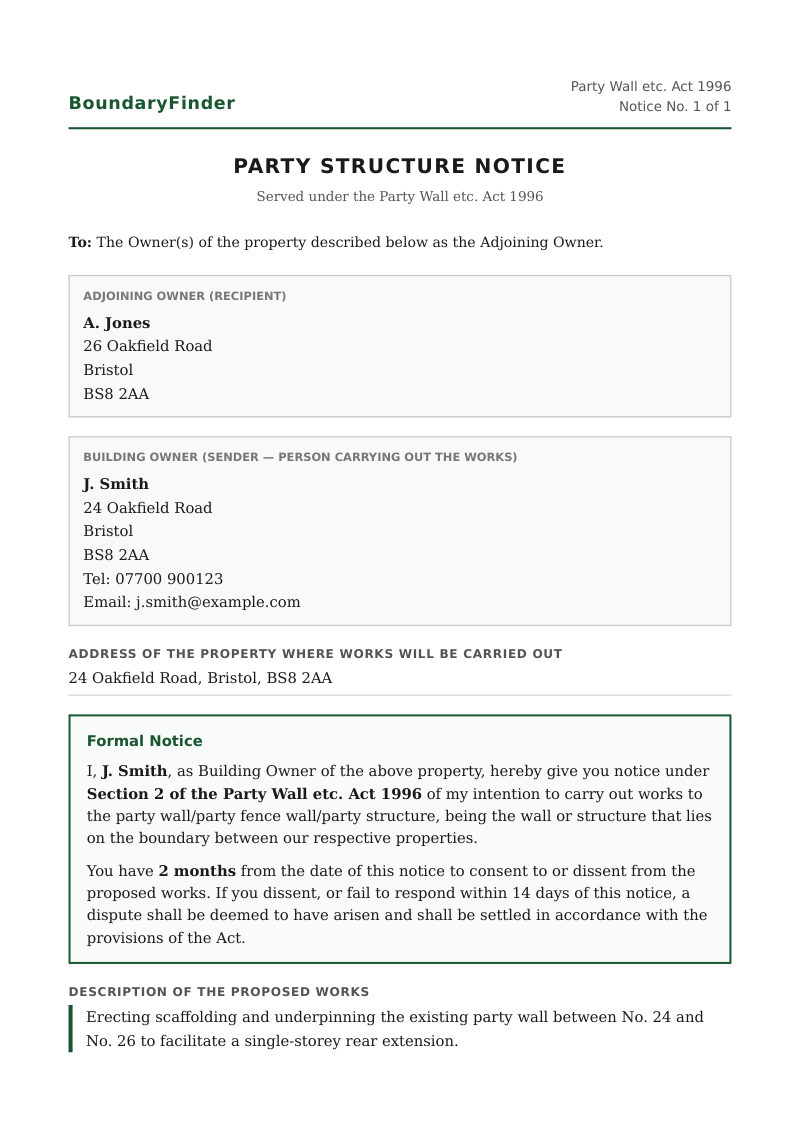
Fill in your details and our party wall template generates your legally compliant notice and consent letter as an instant PDF. Hand them to your neighbour — when they sign the consent letter, your party wall agreement is complete.
-
All three notice types covered — Party Structure, Line of Junction, and Excavation Notice. Select the one that matches your works.
-
Consent letter included — your neighbour signs it and your party wall agreement is legally complete. No surveyor required in most cases.
-
Instant PDF delivery — notice and consent letter emailed immediately after payment. Print, sign, and hand them over.
-
Legally protects you before work begins — a correctly served notice is required by law. Missing or incorrect notices can result in an injunction stopping your works.
-
Covers England & Wales — drafted to the requirements of the Party Wall etc. Act 1996.
-
Free 16-section Party Wall Guide included — homeowner’s PDF covering which notice you need, legal deadlines, what to do if your neighbour disputes, and when to appoint a surveyor.
Fill in your party wall template below
Enter your details and we’ll generate your party wall notice and consent letter instantly as a PDF — your neighbour signs the consent letter and your party wall agreement is complete. Print, sign, and hand them over.
Frequently Asked Questions
What is a party wall agreement?
A party wall agreement is the outcome you need before carrying out building works near a shared wall or boundary. Under the Party Wall etc. Act 1996, you get a party wall agreement in one of two ways: (1) you serve a party wall notice on your neighbour, they sign the consent letter, and that signed notice and consent letter together form your agreement — the most common outcome; (2) if your neighbour disputes the works, both sides appoint surveyors who produce a formal Party Wall Award. BoundaryFinder generates the notice and consent letter so your neighbour can sign and complete the agreement quickly.
Do I need to serve a party wall notice?
Yes. Under the Party Wall etc. Act 1996, you must serve a written notice on all adjoining owners before carrying out any work that affects a shared (party) wall, involves building on or near a boundary, or requires excavating within 3–6 metres of a neighbouring building. Failure to do so can result in an injunction stopping your work, and any work already done may need to be undone at your cost.
What are the three types of party wall notice?
The Party Wall etc. Act 1996 provides three notice types: (1) Party Structure Notice — for works to an existing shared wall, such as extensions, conversions, or underpinning; (2) Line of Junction Notice — for building a new wall on or at the boundary line; (3) Excavation Notice — for digging within 3 metres of a neighbouring structure to a depth below their foundations, or within 6 metres under the 45-degree rule. BoundaryFinder covers all three.
How much notice must I give before starting work?
A Party Structure Notice must be served at least two months before work begins. A Line of Junction Notice and an Excavation Notice each require one month's notice. Work cannot begin until the notice period has expired and the adjoining owner has either consented in writing or surveyors have been appointed to produce a Party Wall Award.
What is the difference between a party wall notice and a party wall agreement?
A party wall notice is the written document you serve on your neighbour — it is the first step. A party wall agreement (also called a Party Wall Award) is the end result: either your neighbour signs the consent letter (most common outcome), or appointed surveyors produce a formal award if your neighbour disputes. BoundaryFinder generates the notice and consent letter for the simpler, consent-based route.
What happens if my neighbour doesn't respond to the party wall notice?
If your neighbour does not respond within 14 days of service, a dispute is deemed to have arisen under the Act. Both parties must then appoint surveyors (or agree on a single 'agreed surveyor') to draw up a Party Wall Award. This process adds cost and delay — typically £1,000–£3,000 in surveyor fees. Serving a clear, correctly drafted notice with a consent letter minimises the chance of a dispute.
How much does a party wall agreement cost?
A solicitor typically charges £200–£500 to draft a party wall notice, and a party wall surveyor bills £150–£300 per hour. If your neighbour disputes and appointed surveyors are needed, total costs can reach £1,000–£3,000. BoundaryFinder generates the party wall notice and consent letter for a one-off fee of £34.95. Most neighbours consent without a dispute, so this is all most homeowners ever need.
Does a party wall notice need to be in a specific format?
The Party Wall etc. Act 1996 does not prescribe a mandatory form, but the notice must contain specific information: the building owner's name and address, the adjoining owner's name and address, a description of the proposed works, the planned start date, and a statement that it is served under the Act. BoundaryFinder produces notices that meet all legal requirements and can be served on up to five adjoining owners.
What is a party wall template?
A party wall template is a ready-made document that fills in the legal wording required by the Party Wall etc. Act 1996 for you. Instead of drafting a notice from scratch, you enter your details and BoundaryFinder's party wall template generates a correctly worded notice and matching consent letter as an instant PDF, ready to print and serve on your neighbour.
Legal Disclaimer. This page is for general information only and is not legal advice. Party wall matters are fact-specific — always consult a qualified party wall surveyor or solicitor if you are in any doubt about your rights or obligations under the Party Wall etc. Act 1996. BoundaryFinder is not a law firm, is not regulated by the Solicitors Regulation Authority, and provides a document template service only — not a substitute for professional representation. Our total liability for any document purchased is limited to the amount paid, and we accept no liability for consequential or indirect losses, including injunction costs, surveyor fees, or legal costs arising from its use.
Sample Party Wall Notice
Sample Consent Letter