
Adverse Possession Notice —
Boundary Encroachment Protection for Registered Land
If you believe a neighbour’s fence, garage, shed or extension may have crossed onto your registered land, a formal Boundary Encroachment Notice is the step that puts your objection in writing. Served by Royal Mail Special Delivery, it removes the “without consent” element of any future adverse possession claim under the Land Registration Act 2002 and creates a dated paper trail. Only you can assess whether encroachment has occurred — based on what you have personally observed on the ground.
From £11.95 — Instant PDF download
Step 1 View Your Registered Boundary (Optional)
Enter your postcode to see the registered general boundary position for your property on the map — free. This is the HM Land Registry INSPIRE polygon, shown here for reference. It is an approximate general boundary under Section 60 of the Land Registration Act 2002, not a legally determined line. It is not used to assess whether encroachment has occurred — only you can make that assessment based on what you have observed on the ground.
OS Map shows the most accurate boundary alignment. Satellite imagery may appear slightly offset due to how aerial photos are georeferenced.
Step 2 Generate your Boundary Encroachment Notice
Fill in your details below. Your notice will be generated instantly as a PDF after payment — delivered by email with full serving instructions.
What Each Document Does to Protect Against Adverse Possession
Boundary Encroachment Notice
If you have personally observed that a neighbour’s structure may have crossed onto your registered land, this is the formal written step to put your objection on the legal record. A solicitor-style letter addressed to your neighbour asserting your registered title — served by Royal Mail Special Delivery with proof retained — removes the “without consent” element of any adverse possession claim, creates a dated paper trail, and defeats the Third Condition “reasonable belief” argument under paragraph 5(4) of Schedule 6, LRA 2002.
Adverse Possession Timeline Under the Land Registration Act 2002

The adverse possession process for registered land under Schedule 6, LRA 2002. Acting before the 10-year threshold is the most effective protection for a registered proprietor.
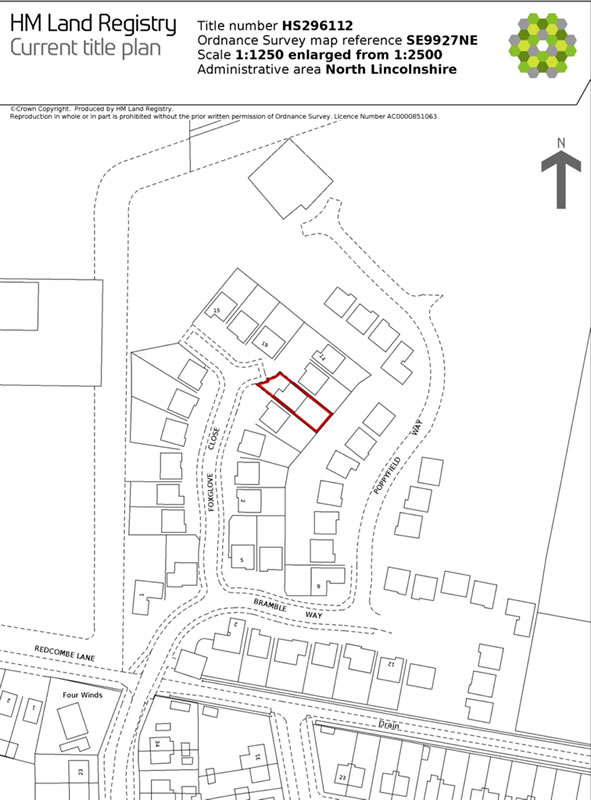
HMLR Title Plan
Your official HM Land Registry Title Plan — sourced directly from HMLR — showing your title number and the general extent of your registered boundary on an Ordnance Survey map base. Attach it to the Boundary Encroachment Notice to make clear exactly which registered title you are asserting. It also shows any rights of way or covenants affecting your title.
Boundary Report
GPS and Easting/Northing coordinates for every corner of your INSPIRE boundary polygon, plotted on a satellite map with your boundary highlighted in orange. Use it to walk the general boundary extent on the ground and assess approximately where the encroachment may cross the registered line. The coordinates are indicative general boundaries under s.60 LRA 2002 — not a substitute for the official HMLR Title Plan or a boundary determination by a chartered surveyor.
Adverse Possession FAQ — Common Questions Answered
What is adverse possession in England and Wales?
Adverse possession is a legal process under the Land Registration Act 2002 by which a person who has occupied registered land for 10 continuous years without the owner's consent can apply to HM Land Registry (Form ADV1) to be registered as the new owner. The existing registered owner is notified using Form NAP and has 65 working days to object. If no objection is made, the applicant may be registered in place of the original owner.
Acting before 10 years have elapsed is the most effective way to defeat a claim.
What is property or land encroachment?
Property encroachment (also called land encroachment or boundary encroachment) is when a neighbour's structure — such as a fence, shed, garden wall, driveway, outbuilding, or extension — crosses your registered land boundary onto your property. If left unchallenged for 10 continuous years, the encroachment can give rise to an adverse possession claim under the Land Registration Act 2002.
What is a Boundary Encroachment Notice?
A Boundary Encroachment Notice is a formal written letter asserting your registered title over land being encroached upon by a neighbour. When served by Royal Mail Special Delivery, it removes the 'without consent' element of an adverse possession claim — an essential condition that must be satisfied before any application to HMLR can succeed.
It also defeats the Third Condition reasonable-belief argument under paragraph 5(4) of Schedule 6 to the Land Registration Act 2002 and creates a permanent, dated paper trail of your objection.
How do I stop a neighbour claiming my land?
The most effective step is to serve a formal Boundary Encroachment Notice on the registered owner of the neighbouring property by Royal Mail Special Delivery Guaranteed. Keep the certificate of posting and delivery confirmation permanently.
This removes the 'without consent' element that is essential to any adverse possession claim, and creates a provable legal paper trail. Act before 10 continuous years of occupation have elapsed — once an ADV1 application is made to HMLR, you only have 65 working days to object before the land may be transferred.
My neighbour's fence crosses my boundary — what should I do?
If fewer than 10 continuous years have passed since the fence was erected over your boundary, serving a Boundary Encroachment Notice now removes the 'without consent' element and resets the adverse possession clock. The notice must be served on the registered owner (not just the occupier) by Royal Mail Special Delivery Guaranteed, with proof of postage retained.
To confirm the exact registered boundary position, order an HMLR Title Plan or use the GPS Boundary Report to see where the registered line sits on the ground.
How does adverse possession work for registered land?
Under the Land Registration Act 2002 (which applies to registered land), the claimant must have been in factual possession with the requisite intention to possess for at least 10 continuous years. They then apply using Form ADV1. HMLR notifies the registered owner using Form NAP. The owner has 65 working days to serve a formal objection — if they do, the application is rejected and the 10-year clock resets.
The older 12-year limitation period under the Limitation Act 1980 does not apply to registered land for claims arising after 13 October 2003.
Do I need a solicitor to serve an encroachment notice?
No. A Boundary Encroachment Notice is a written document and does not require a solicitor to be legally effective. The key requirements are that it clearly asserts your registered title over the encroached land, names the encroaching party, and is served by a method that provides proof of delivery — Royal Mail Special Delivery Guaranteed is the recommended method.
However, if the encroachment is part of an active dispute or if legal proceedings are likely, consulting a property solicitor is advisable.
What documents do I need to prove my registered boundary?
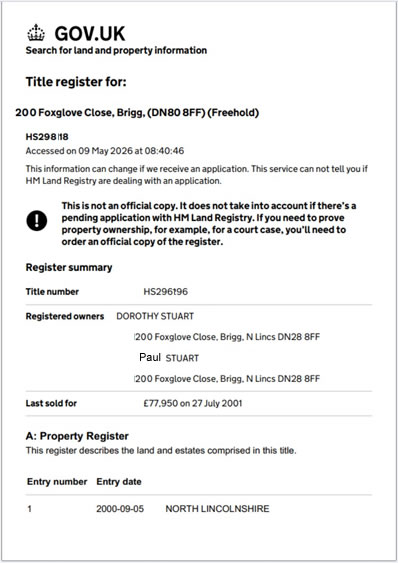
The primary documents are your HMLR Title Register (confirms your ownership and title number) and HMLR Title Plan (shows the registered boundary extent edged in red on an OS base map). Together, these are the official evidence of the registered title. You can order both as official copies from HM Land Registry via BoundaryFinder. A GPS Boundary Report can additionally show the general extent of the registered line on the ground — indicative GPS coordinates useful as supporting context, but not a boundary determination.
Legal Disclaimer. The information on this page is for general informational purposes only and does not constitute legal advice. Adverse possession and boundary disputes involve complex factual and legal questions. Always consult a qualified solicitor before serving notices or taking any action that may affect a neighbour’s property. BoundaryFinder is not a law firm. The Boundary Encroachment Notice is a document template service — it is not legal advice or a substitute for specialist legal representation. To the fullest extent permitted by law, BoundaryFinder’s total liability to you in connection with any document purchased through this service is limited to the amount you paid for that document. BoundaryFinder accepts no liability for any consequential, indirect, or special loss, including loss of land, legal costs, or any other losses arising from the use of any document generated by this service.
Sample Boundary Encroachment Notice

Sample HMLR Title Register
Sample HMLR Title Plan
Sample GPS Boundary Report

Adverse Possession Timeline — Land Registration Act 2002