
Fence Ownership Guide
The Complete Guide to Fence Ownership in England & Wales
A practical guide to T-marks, H-marks, the left-or-right myth, deed plans, and the main documents people use to investigate which fence may belong to them. It is general information only, not legal advice.
Key Takeaway
T-marks on your title plan indicate which owner is responsible for maintaining a boundary feature. The foot of the T points towards the responsible owner’s land. However, a T-mark only has legal force if the original deed expressly referred to it in writing and that wording was carried into the title register. There is no left-or-right rule in English law.

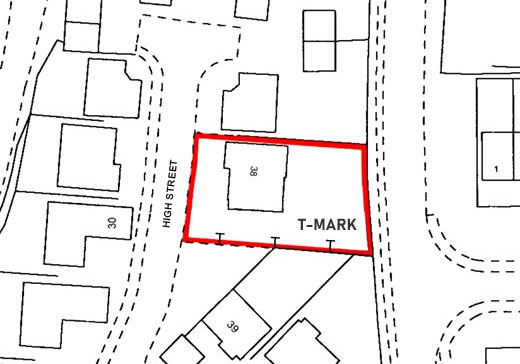
T-marks on a deed plan. The foot of the T indicates the responsible side.
When a title register states “the owner of the land is responsible for the boundary marked T on the filed plan”, this refers to the original conveyance deed plan — not necessarily the current title plan. Both documents need to be read together.
Where two T-marks appear back-to-back forming an H (sometimes called an H-mark), this indicates shared ownership or responsibility for that boundary feature.
Where no T-marks exist — which is common — that boundary feature is generally treated as a party boundary: jointly owned and maintained by both neighbours.
What Are T-Marks?
T-marks are symbols found on deed plans and sometimes on title plans. They have a specific legal significance relating to boundary ownership and maintenance responsibility in England and Wales.
As confirmed by HM Land Registry in Practice Guide 40:
“An entry referring to a ‘T’ mark is normally a statement concerning the ownership of a boundary structure or the liability to maintain and repair it.” — HM Land Registry, Practice Guide 40

The foot of the T sits on the land of the owner responsible for the boundary.
How to Read a T-Mark
- The cross of the T sits on the boundary line
- The foot of the T extends into the land of the responsible owner
- Whoever’s land the foot points toward is responsible for that boundary feature
- The title register must contain the corresponding wording for the T-mark to have legal effect
When Do T-Marks Have Legal Force?
This is the most commonly misunderstood aspect of T-marks. HMLR is explicit:
“‘T’ marks on deed plans which are not referred to in the text of a deed have no special force or meaning in law and unless an applicant specifically requests that the T marks be shown on the title plan, it will normally be ignored.” — HM Land Registry, Practice Guide 40
A T-mark has legal effect as a boundary obligation when:
- It appeared on the original deed plan
- The text of the deed expressly referred to it (e.g. “the owner shall maintain the boundary marked T”)
Registration in the title register is not a condition of enforceability — but it does affect how the obligation binds future owners. A T-mark obligation that was never entered into the register may not automatically bind a subsequent purchaser for value under Section 29 of the Land Registration Act 2002. However, on estate-built properties, the building scheme doctrine typically makes the obligation mutually enforceable between all plot owners regardless of whether it was registered. See Where Are My T-Marks? for more on recovering unregistered T-mark obligations.
If the T-mark was drawn on an old deed plan but the deed text never mentioned it, it carries no legal weight.

An example of the deed wording that gives a T-mark legal binding force — the deed text must expressly refer to the T-mark for it to take effect.
H-Marks & Shared Boundaries
When both owners share responsibility for a boundary, this is indicated by a different mark altogether.
One owner is solely responsible. The foot of the T points toward their land. Common on residential plots from the original development.
Two T-marks back-to-back form an H. Both owners share responsibility for that boundary feature. Any replacement or alteration requires agreement from both parties.

An H-mark (two T-marks back-to-back) indicates shared boundary responsibility between both neighbours.
Where a boundary has an H-mark, neither owner may alter or replace the fence unilaterally. Any work requires the other owner’s agreement. If agreement cannot be reached and the fence needs repair, the matter may need to be resolved through mediation or, as a last resort, through the First-tier Tribunal (Property Chamber).
Does a T-Mark Mean I Own the Fence?
Not necessarily. This is a critical distinction that many property owners misunderstand — and which the Court of Appeal confirmed definitively in 2013.
English courts have confirmed that a T-mark indicating maintenance responsibility does not automatically confer ownership of the boundary feature. A covenant to maintain a boundary structure is a separate legal obligation from ownership of that structure. The two are distinct concepts under English property law, and this distinction is expressly recognised in HM Land Registry Practice Guide 40.

Ownership and maintenance responsibility are legally distinct — a T-mark establishes one, not necessarily both.
In plain terms:
- A T-mark pointing toward your land means you are likely responsible for maintaining that fence
- It does not automatically mean you own the fence as a structure
- A maintenance covenant in a deed similarly creates an obligation to maintain but does not confer ownership
- Where the deed is silent on ownership, and only refers to maintenance, ownership is indeterminate from the T-mark alone
The practical consequence: even if the T-mark is in your land, you may not legally be entitled to remove, replace, or materially alter the fence without your neighbour’s agreement, depending on the specific wording in your deeds.
The Left-or-Right Myth — and Other Misconceptions
Several popular beliefs about fence ownership have no basis in English law. HM Land Registry and the courts have repeatedly confirmed this.
“There are various notions that the way a wall or fence is constructed indicates ownership, for example that the posts and arris rails of a fence are on the owner’s side. There is, however, no legal foundation for such beliefs.” — HM Land Registry, Practice Guide 40 Supplement 3

There is no universal left-or-right rule. The answer lies in the title documents, not the fence construction.
Common Myths — Debunked
- “I own the fence on the left” — No legal basis. There is no default rule assigning left-hand fences to either owner.
- “I own the fence on the right” — Also no legal basis. The same applies.
- “The fence posts face my side, so it’s mine” — No legal basis. Post orientation indicates nothing about ownership.
- “The arris rails are on my side, so it’s my fence” — No legal basis. Explicitly rejected by HMLR and the courts.
- “Because I maintain it, I own it” — Not automatically. Maintenance and ownership are separate legal concepts (see Lanfear v Chandler).
The main documents to examine are your title plan, title register, and where available, the original conveyance deed plan. They carry the most weight in this area, but they should be read carefully and, where needed, checked with a solicitor or surveyor.
Which Side of the Fence Is Mine When There Are No T-Marks?
A very large proportion of residential properties in England and Wales have title plans with no T-marks at all. This is entirely normal and does not mean the boundary is unresolvable.
Why are T-marks missing from most title plans?
T-marks originate in original conveyance deeds — the solicitor-drawn documents from when a plot was first sold individually, typically in the 1960s–1990s. When the property was later registered with HM Land Registry, the solicitor was required to lodge the deed plan, but the T-mark information was only carried forward into the title register if the conveyance wording was expressly copied into the register entries. In practice, this step was routinely missed.
The result: the T-marks exist in the original paper deed, but never made it into the registered title. For properties registered before compulsory first registration became universal in 1990, this gap is especially common. Millions of properties are registered with a title plan that shows no T-marks, even though the original conveyance plan that the title is based on did contain them.
If you want to know whether T-marks do exist for your property but simply were not carried forward, you need to order the filed documents from HMLR — the original deed plan lodged at registration, not just the current title plan. See the Deed Plans section below for how to do this.
Read the full history: Why T-mark records were lost in England & Wales →

Where no T-marks exist, a boundary fence is generally treated as jointly owned by both neighbours.
Where fence ownership or maintenance responsibility cannot be determined from the title documents, that boundary feature is generally best regarded as a party boundary under HMLR guidance. This means:
- Both neighbours share responsibility for the fence
- Neither owner should alter, remove, or replace it without the other’s agreement
- If agreement cannot be reached, a boundary dispute process may be required
It is worth checking not just your own documents, but also asking your neighbour to check theirs. Occasionally T-marks appear on one title but not the adjoining one, which can itself be informative.
If neither title has T-marks and the original deeds are unavailable, it may be necessary to seek a formal boundary agreement with your neighbour or apply to HMLR for a determined boundary under Section 60(3) of the Land Registration Act 2002.
Deed Plans vs the Title Plan
Understanding the difference between these two documents is essential to interpreting T-marks correctly.
The Title Plan
The title plan is the current official map produced by HM Land Registry for your registered title. It shows the extent of your registered land (the red outline) on an Ordnance Survey base map. It shows a general boundary only — it does not define the precise legal line on the ground. T-marks may or may not be shown on it.
The Deed Plan
A deed plan is the plan attached to an original conveyance deed — often a document from the 1960s–1990s when a plot was first sold individually. These plans were drawn by solicitors specifically for that transaction and frequently contain much more boundary detail: T-marks, measurements, and written descriptions of boundaries. This is where T-marks originate.
When a title register entry says “the owner is responsible for the boundary shown T on the filed plan”, the “filed plan” is the original deed plan lodged with HMLR at registration — not the current title plan. To see the T-marks in full context, you need to order the filed documents from HMLR.
What to Order
- Official Copy of Title Register — read Sections B and C carefully for any entries describing boundary maintenance obligations. The T-mark obligation is often captured as register text (e.g. “the registered proprietor is responsible for the boundary marked T on the filed plan”) even when no T-mark appears visually on the title plan. This is the free first check before ordering any other documents.
- Official Copy of Title Plan — the current map, which may show T-marks if they were copied from the deed at registration
- Filed documents — the original deed plan (typically a TR1 for post-1990 new builds, or the original conveyance for older properties), ordered separately from HMLR if the register refers to “the filed plan”
Get Your Official Title Documents
Your Title Plan and Title Register are the only documents that can legally establish which fence is yours. Delivered instantly as PDF — no postal wait.
Order Title Plan & Register →📍 Know Your Registered General Boundary
Under Section 60 of the Land Registration Act 2002, INSPIRE Index Polygons represent the registered general boundary position — not a determined legal line on the ground. Our GPS Boundary Report overlays that boundary on a satellite map with GPS coordinates for every boundary point, so you can walk the approximate registered extent before any fence inspection or dispute.
Find My Property & Order GPS Boundary Report →How to Find Out Which Fence Is Mine — Step by Step

Start with the official HMLR title documents — they are the only legally reliable source.
Order your Title Register and Title Plan
These are the Official Copies from HM Land Registry. They constitute the primary legal evidence of your boundary obligations. Both are available instantly as PDF from BoundaryFinder.
Read the title register entries about boundaries
Look in the Charges Register or the Proprietorship Register for entries that mention “boundary”, “fence”, “wall”, “maintain”, or “T mark”. Note exact wording.
Check the title plan for T-marks or H-marks
Look at the boundary lines on the title plan for T or H symbols. If the register refers to “the filed plan”, you will need to order the filed documents from HMLR to see the original deed plan.
Ask your neighbour to check their title too
T-marks sometimes appear on the neighbouring title even when absent from yours. Comparing both title plans gives the full picture.
If still unclear, treat it as a party boundary
Where neither title document resolves the question, the fence is a party boundary. Both owners share responsibility; neither may alter it unilaterally. For a formal resolution, consider a boundary agreement, HMLR application, or legal advice.
Frequently Asked Questions About Fence Ownership
There is no legal left-or-right rule in England and Wales. This is one of the most pervasive myths in property law. HM Land Registry explicitly states there is “no legal foundation for such beliefs.” The answer can only be found in your title documents.
Check both title plans (yours and your neighbour’s) for T-marks. If the foot of the T points toward your land, you are likely responsible for that boundary. If there are no T-marks on either title, the fence may be a party boundary, but you should still check the deed wording and any filed documents before treating it as settled.
This depends entirely on the T-mark position in your deed or title plan, and the wording in the title register. If the register is silent, neither “side” is definitively yours in a legal sense — the boundary may be a party boundary, but the deed wording and filed documents still matter.
Order your Official Copy of Title Plan and Title Register from HM Land Registry (available instantly via BoundaryFinder). Read the register for any boundary maintenance entries and check the title plan for T-marks. If the register refers to “the filed plan”, also order the filed documents to see the original deed plan.
Your title plan will have T-marks on specific boundary edges of your plot — not necessarily on all four sides. Each T-mark refers to a specific boundary structure. Where a boundary has no mark at all, it is generally treated as shared. The title register will describe the relevant boundaries in plain text if entries exist.
No. There is no legal rule in England and Wales that post orientation or rail position indicates fence ownership. This belief is explicitly rejected by HM Land Registry: “there is no legal foundation for such beliefs.”
Not automatically. In Lanfear v Chandler [2013], the Court of Appeal confirmed that maintenance responsibility and ownership are distinct legal concepts. A covenant to maintain a boundary does not confer ownership of it. You may be obliged to maintain a fence you do not own.
This is common. Where no T-marks exist on either title, the boundary is often treated as a party boundary — but the deed wording, filed documents, and any other boundary evidence still need to be checked before making that assumption. Any alterations or replacements should only be done with the agreement of the adjoining owner.
T-marks on a deed plan. The foot of the T indicates the responsible side.

The foot of the T sits on the land of the owner responsible for the boundary.
An H-mark (two T-marks back-to-back) indicates shared boundary responsibil…

Ownership and maintenance responsibility are legally distinct — a T-mark e…
There is no universal left-or-right rule. The answer lies in the title doc…

Where no T-marks exist, a boundary fence is generally treated as jointly o…

Start with the official HMLR title documents — they are the only legally r…

Legally Binding T-Mark Wording in a Conveyance Deed