Fencing Conventions & Building Practices
When the Fence Itself Tells You Who Owns It — England & Wales
When title documents and common law presumptions do not settle the question, established building conventions can provide a reliable practical clue. Understanding what a fence’s construction tells you — and its limits as evidence — is essential knowledge for any property owner or practitioner.
The Evidence Hierarchy for Fence Ownership
Before considering what the physical construction of a fence or boundary tells you, it is important to understand where building conventions sit in the overall framework of evidence. There are three layers, each overriding the one below:
The Title Register and Title Plan are the primary legal record. T-marks, wording in Section A, and deed entries take precedence over everything else. Always start here.
Where documents are silent, High Court decisions provide default rules: hedge & ditch, road centre line, party wall centre. These bind lower courts unless rebutted by evidence.
Where documents and presumptions leave the matter open, established building practices can provide a practical starting point. They are persuasive, not legally binding.
Building conventions are rebuttable guides, not legal rules. A fence may have been erected by the wrong owner, built incorrectly, or replaced in a different configuration over time. The title documents must always be checked first. If they are clear, the convention is irrelevant. If they are silent, the convention becomes a useful starting point for discussion.
Post & Rail Fence Convention

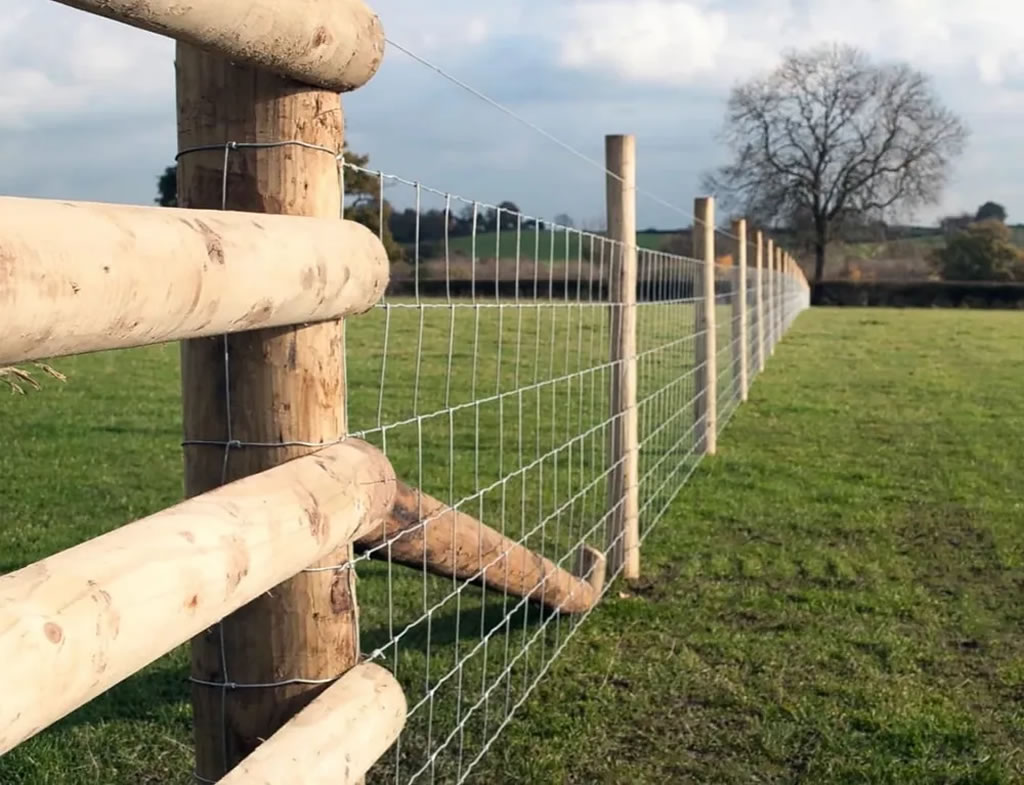
Posts and diagonal struts visible on the owner’s side — the convention places the boundary on the far side of the fence, away from the struts.
A post and rail fence (also called a post and strut fence) is a common type of garden boundary where the posts, with their horizontal rails or diagonal struts, are visible on one side. It is often used where privacy is not a primary consideration.
The established building convention is:
The owner erects the fence with the posts and struts facing into their own garden. All structural elements — posts, diagonal bracing struts, and cross-rails — sit within the owner’s land, running along the boundary.
The Logic Behind This Convention
The reasoning is straightforward. A conscientious owner, knowing the position of their boundary, would ensure that all parts of the fence — including the posts and struts — sit within their own land. Placing the struts facing outward (towards the neighbour) would mean the fence slats on which the rails are fixed would sit further into the owner’s own garden, reducing their usable space. It also risks having the posts project over the boundary.
Where a fence with posts and struts is observed, the convention implies that the owner’s boundary runs along the far side of the fence from where the struts are facing. In other words: if the posts face your garden, the fence is likely yours.
The posts and struts face into the owner’s garden.
Post & rail is an open fence — both sides look similar. The convention is about structural orientation only, not a finished “smooth face”.
The convention may not apply where:
- The fence was erected by the wrong owner or a previous occupier unfamiliar with the boundary position
- The fence has been replaced and the convention was not followed on rebuilding
- T-marks in the title documents assign responsibility to the other party — this overrides the convention entirely
- The fence was jointly funded or erected by both neighbours
Closeboard & Panel Fence Convention

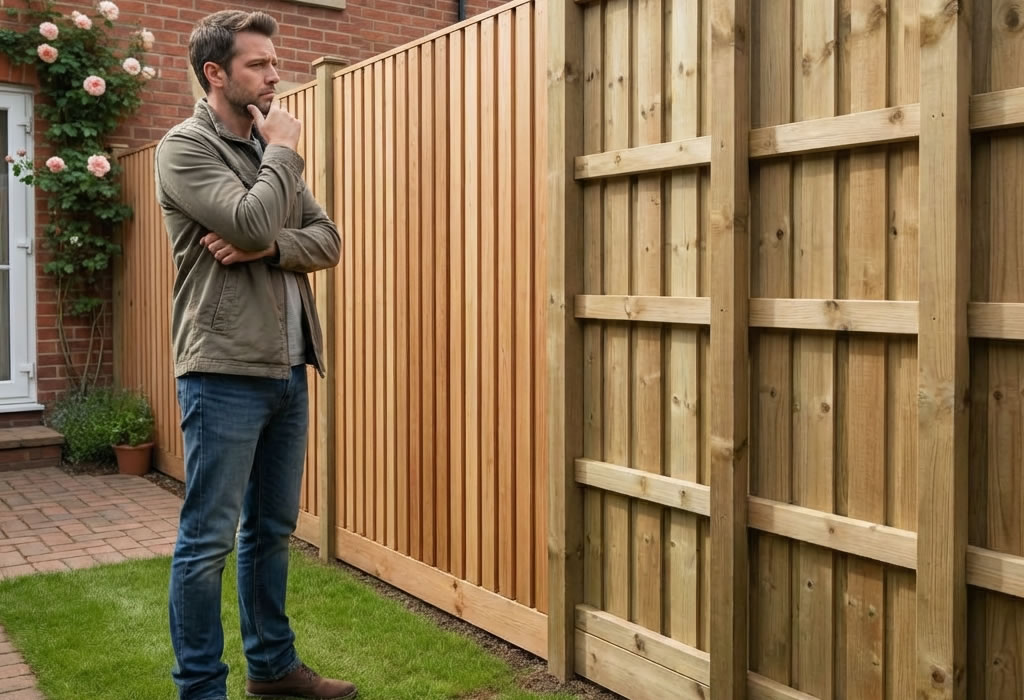
Arris rails and capping rail visible on the owner’s side — the featheredge boards face the neighbour.
Closeboard fencing (also called featheredge fencing) is the most common residential boundary fence in England. It consists of overlapping tapered vertical boards fixed to horizontal arris rails, which are in turn fixed to upright posts. Panel fencing follows the same logic.
Unlike post and rail, closeboard fencing has a clear visual distinction between its two faces. The structural back — posts, arris rails, fixing nails, and the rough or barked edge of the featheredge boards — faces into the owner’s garden. The smooth, overlapping board face presents a clean finish towards the neighbour.
Vertical posts, horizontal arris rails, post caps, fixing nails or screws, and the bark or rough side of the featheredge boards.
The smooth, finished face of the overlapping featheredge boards presents a clean surface towards the neighbouring property.
This same logic applies to standard fence panels in concrete or timber post frames: the posts, panel frames, and fixings should be on the owner’s side of the boundary, with the flat panel face visible from the neighbour’s garden.
Why This Seems Backwards
Many owners instinctively want the smooth, clean face of a new closeboard fence facing into their own garden — they paid for it, so they want to see the nice side. In some countries (notably New Zealand) there is no established convention either way, which is precisely why this becomes a source of neighbour disputes.
In England and Wales the convention runs the other way for a boundary-integrity reason: a builder working correctly at the edge of their client’s land ensures every structural element sits within that land. The posts are sunk into the owner’s soil; the arris rails span between those posts on the owner’s side; the featheredge boards are nailed to the arris rails with their smooth face naturally presenting outward. Building it the other way — smooth face inward — would require the posts to sit right on, or even over, the boundary line, risking encroachment onto the neighbour’s land.
In practice many owners do build it with the smooth face inward, which is exactly why this convention is unreliable and why disputes still arise.
When This Convention Is Unreliable
- The owner built the fence smooth-face inward (a common choice in practice) — the convention is simply not followed
- The fence has been replaced since original erection with no guarantee the convention was observed
- T-marks in the title documents assign ownership to the other party — this overrides the convention entirely
- The fence was jointly funded or erected jointly — neither orientation has evidential value
Why “Which Side of the Fence Is Mine?” Has No Single Legal Answer
There is no statutory rule in England and Wales that assigns fence maintenance responsibility by position relative to the viewer (left, right, or facing direction). The left-hand rule and right-hand rule are myths that circulate online but have no basis in property law. Ownership is always established by the title documents first — see our fence ownership T-marks guide for the full explanation. The building convention described here is a practical starting point where documents are genuinely silent.
Garden Wall Convention

Outer face aligned to the boundary edge — the builder used his own land fully.
For garden walls (as opposed to party fence walls, covered below), the equivalent building convention is:
Where a garden wall has been erected without any documentary evidence specifying the boundary position, it is presumed to sit with its outer face on the edge of the owner’s land, so that the entirety of the wall — including its foundations — is within the owner’s boundary.
The reasoning mirrors the fence convention: a builder constructing a wall at the edge of their property would build with the outer face flush with the boundary, ensuring no part of the wall encroaches onto the neighbour’s land. This means the boundary runs along the outer face of the wall as seen from the neighbour’s side.
Practical Implication
If you can see the outer (finished) face of a garden wall from your property, the wall generally belongs to your neighbour. You have no right to attach anything to it, paint it, or alter it without their consent. However, the Access to Neighbouring Land Act 1992 provides a mechanism to carry out basic preservation work to the exterior of your own house walls where access from your own land is not possible — written notice must be given and access cannot unreasonably be refused.
Ownership Indicated by the Outward-Facing Side
Where a garden wall sits entirely on one side of the boundary (NOT astride it), the convention is that ownership is indicated by the outward-facing side of the wall. The neighbour on whose side of the boundary the outer face is visible cannot alter or attach to the wall without the owner’s consent, even though the smooth face is in their garden.
Party Fence Walls & the Party Wall etc. Act 1996

A party fence wall sits astride the boundary — each owner owns their half and neither can act unilaterally.
A party fence wall is a wall that is:
- Solidly constructed (brick, stone, block — not timber, hedges, or other perishable materials)
- Not attached to the main building of either property
- Sitting astride the boundary between two properties in separate ownership
Party fence walls are governed by statute — the Party Wall etc. Act 1996 — rather than by building conventions or common law presumptions. The Act applies because the wall straddles the legal boundary and neither owner can perform significant works to it without serving formal notice on the other.
Key Distinctions
A wooden fence is not a party fence wall. Section 20 of the Party Wall etc. Act 1996 specifically defines a party fence wall as a wall that is not part of a building but that stands astride the boundary and is made of brick, stone, or other permanent material. A wooden or panel fence is not within the Act’s scope, though it may be a “party fence” (shared ownership) in the general sense.
A wall that does not straddle the boundary is not a party fence wall. If a garden wall sits entirely on one side of the boundary, it is simply a boundary wall belonging to the owner on whose land it stands. The Act does not apply. Building conventions (outer face = boundary position) govern instead.
Important Consequence
Where a party fence wall does straddle the boundary, the common law presumption is that the boundary runs through the centre of the wall. Each owner holds their half. Neither may tear down or materially alter the wall without the formal process of the Party Wall etc. Act 1996 — which involves serving notice, agreeing awards, and (if required) appointing a party wall surveyor.
Check Your Title Documents First
Building conventions are a useful guide only where the title documents are silent. Before relying on post orientation or wall faces, check the Title Register and Title Plan — T-marks, register entries, and deed wording take precedence over all conventions.
Order Title Plan & Register →Hedge & Ditch Convention

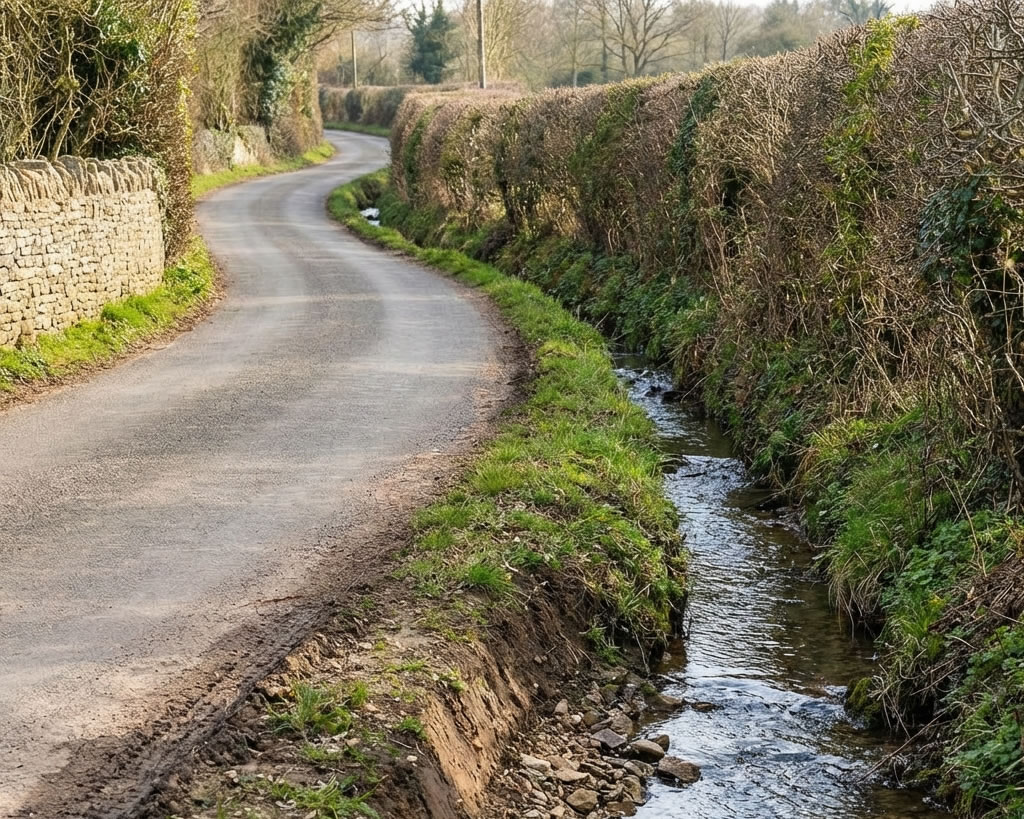
The hedge and ditch rule: the owner dug the ditch within their own land, threw the spoil back to form a bank, and planted the hedge on top.
The hedge and ditch rule is one of the oldest common law presumptions about boundary ownership in England and Wales. It arises wherever a boundary feature consists of a hedge growing on an earthen bank with a ditch running alongside it.
Where a hedge with a ditch on one side marks a boundary, the presumption is that the boundary runs along the far edge of the ditch (the edge furthest from the hedge — i.e. the neighbour’s side), and that both the hedge and the ditch belong to the owner on whose side the hedge grows.
The Logic: How Ditches Were Originally Dug
The presumption rests on a historical understanding of how farmers and landowners created field boundaries. A landowner wishing to drain or mark their land would:
- Dig a ditch within their own land (they had no right to dig on a neighbour’s land)
- Throw the spoil back onto their own side to form an earthen bank
- Plant a hedge on top of the bank to stabilise it and mark the edge of their property
The result: the ditch lies entirely within the owner’s land, between the hedge and the neighbour’s boundary. The boundary therefore runs along the far edge of the ditch — not through the centre of the ditch, and not along the near edge.
The hedge sits on a bank. The ditch runs between the bank and the neighbouring land.
The owner of the hedge owns the ditch too.
Who Is Responsible for the Ditch?
Ownership of the ditch carries practical obligations. Under the Land Drainage Act 1991, a riparian owner (one whose land adjoins a watercourse or ditch) has a duty not to obstruct the flow of water and to keep the ditch clear of debris that would impede drainage. This obligation sits with the hedge-and-ditch owner, not the neighbouring landowner who merely looks across the ditch.
The rule was confirmed in Vowles v Miller (1810) and has been consistently applied since. It is rebuttable where documentary evidence — a deed, transfer plan, or express note on the title plan — places the boundary at a different position.
When This Presumption Is Unreliable
- The title plan or deed expressly draws the boundary at a different position
- There is evidence of a later boundary agreement between the parties
- The ditch was dug by the neighbouring owner (unusual, but possible)
- Both sides have hedges and ditches — the evidence becomes ambiguous
- The features have been substantially altered, infilled, or removed over time
Boundary Trees & Shrubs

A line of trees along the boundary — ownership follows the land on which the trunk grows.
Trees Entirely on One Side
Where a tree or line of shrubs is growing entirely on one side of the boundary, it belongs to the owner of that land. This is straightforward: the tree is a fixture of the land on which it grows. This principle was confirmed in the Court of Appeal in Fisher v Winch [1939] and followed in Davey v Harrow Corporation [1957].
Important practical points:
- The neighbouring owner may cut back branches or roots that overhang or encroach into their land — but only back to the boundary line. They cannot destroy the tree.
- Fruit on overhanging branches legally belongs to the tree’s owner, not to the neighbour onto whose land it falls.
- Fallen leaves from overhanging branches are not actionable in nuisance unless they cause a specific, material damage beyond the ordinary.
Trees Straddling the Boundary
Where the trunk of a tree straddles the legal boundary — the tree is rooted on both sides — English law generally treats the boundary as running through the centre of the trunk at ground level (where the Title Register and Title Plan clearly indicate a line of trees as a boundary feature).
The practical consequence is that the tree is jointly owned. Neither owner can fell, lop, or remove it without the agreement of the other. Both are responsible for the costs of maintenance.
Four Types of Straddle Tree
Where it is unclear how a tree came to straddle the boundary, the analysis becomes more nuanced. Canadian case authority (persuasive, not binding, in England and Wales) from Loenig v Goebel (1998, Saskatchewan Supreme Court) and Hartley v Cunningham (2013, Ontario Supreme Court) identifies four categories — these cases are helpful guides to how an English court might approach similar facts, but they do not bind the courts here:
Planted on one side of the boundary with the owner’s knowledge of where the boundary lay. Over time, the bole has grown and strayed onto the neighbouring land. Likely to be treated as jointly owned once the trunk genuinely straddles the line.
Deliberately planted astride the boundary by agreement between both neighbours. Both understood the boundary to be jointly owned at the time. Strongest case for joint ownership.
Origin unknown — self-seeded on one side but grown across. The owner on whose land it first self-seeded remains responsible for damage caused to the neighbour, even though not planted deliberately.
The trunk begins on one side at ground level but bends and crosses the boundary as it grows upward. Identified in Hartley v Cunningham (2013) as a Straddle Tree despite having roots only on one side. Persuasive authority for English courts but not binding.
The four-category classification from Loenig v Goebel (1998) and Hartley v Cunningham (2013) represents Canadian law as decided by provincial courts. These are persuasive (not binding) in England and Wales. No English High Court has adopted this classification in full. Where a straddle tree boundary is disputed, specialist legal advice should be sought.
📍 Know Where Your Boundary Is Before You Walk It
Fencing conventions only make sense once you know where the registered general boundary sits. Our GPS Boundary Report shows the registered general boundary position using the official HMLR INSPIRE cadastral dataset — overlaid on a satellite map with GPS coordinates for every boundary point. Order it before your physical inspection so you can compare what you see on the ground against the registered general boundary position.
Find My Property & Order GPS Boundary Report →Fencing Convention Questions
There is no left-hand or right-hand legal rule. Ownership is determined by the title documents first (T-marks, title register entries), then by common law presumptions, and finally by building conventions. If the title documents are clear, conventions are irrelevant. If documents are silent, the building convention (posts facing into the owner’s garden) provides a starting point but is not legally binding.
By convention, yes. The established practice is for an owner to erect the fence with the posts and struts facing into their own garden, placing the smooth outer face of the fence towards the neighbour. This means if you can see the posts and rails from your garden, the fence is likely yours. However, this is a convention only — not a legal rule — and can be overridden by the title documents.
A party fence wall is a solidly built wall (brick, stone, or block) that sits astride the boundary between two properties in different ownership, and is not part of any building. It is governed by the Party Wall etc. Act 1996. A wooden fence or hedge is not a party fence wall. Where a wall straddles the boundary, the common law presumption is that the boundary runs through the centre of the wall, and neither owner may make material alterations without following the Act’s formal notice procedure.
A tree growing entirely on one side of the boundary belongs to the owner of that land. A tree whose trunk straddles the boundary is generally considered jointly owned, with the boundary running through the centre of the trunk. Neither owner can fell a jointly owned tree without the other’s consent. The neighbouring owner may cut back overhanging branches to the boundary line but cannot destroy the tree.
No. If your neighbour owns the wall (i.e. the outer face of their garden wall is visible from your garden), you have no right to paint it, attach brackets, nails, trellis, or any other fixings to it without their consent. The smooth face being visible from your garden does not give you any ownership rights over that face. Any alterations to a wall that is not yours require the owner’s permission.
No. Building conventions are practical guides based on how careful builders and owners tend to construct fences. They have no statutory basis and are not enforceable as legal rules. They become relevant only where title documents and common law presumptions do not resolve the question. Even then, evidence that the convention was not followed (e.g. the previous owner built incorrectly) can rebut the inference. The title documents always take legal precedence.
Post and strut fence — posts and diagonal struts face into the owner’s garden
Hedge & ditch boundary presumption — the far edge of the ditch is the boundary
Arris rails and capping rail visible on the owner’s side — the feath…
Outer face aligned to the boundary edge — the builder used his own l…

A party fence wall sits astride the boundary — each owner owns their…
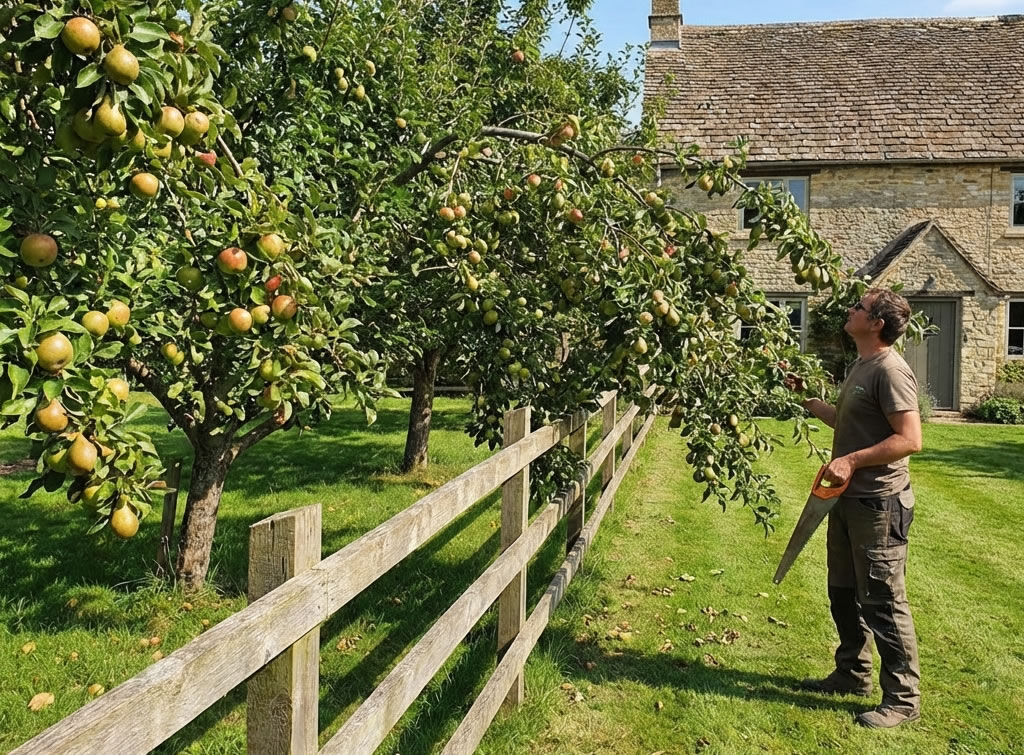
A line of trees along the boundary — ownership follows the land on which t…