Which Fence Is Mine?
Which fence is mine starts with reviewing your HMLR documents for fence ownership, covenants, T-marks and maintenance responsibility.
GPS Boundary Report — £24.95
How to Find Who’s Responsible for the Fence
Fence ownership and covenant details may be found in HMLR documents, but it is not guaranteed — you may need to order more than one document.
Under Section 60 of the Land Registration Act 2002, almost all registered property boundaries in England & Wales are general boundaries. We help you locate and walk yours.
Check Your Official HMLR Documents
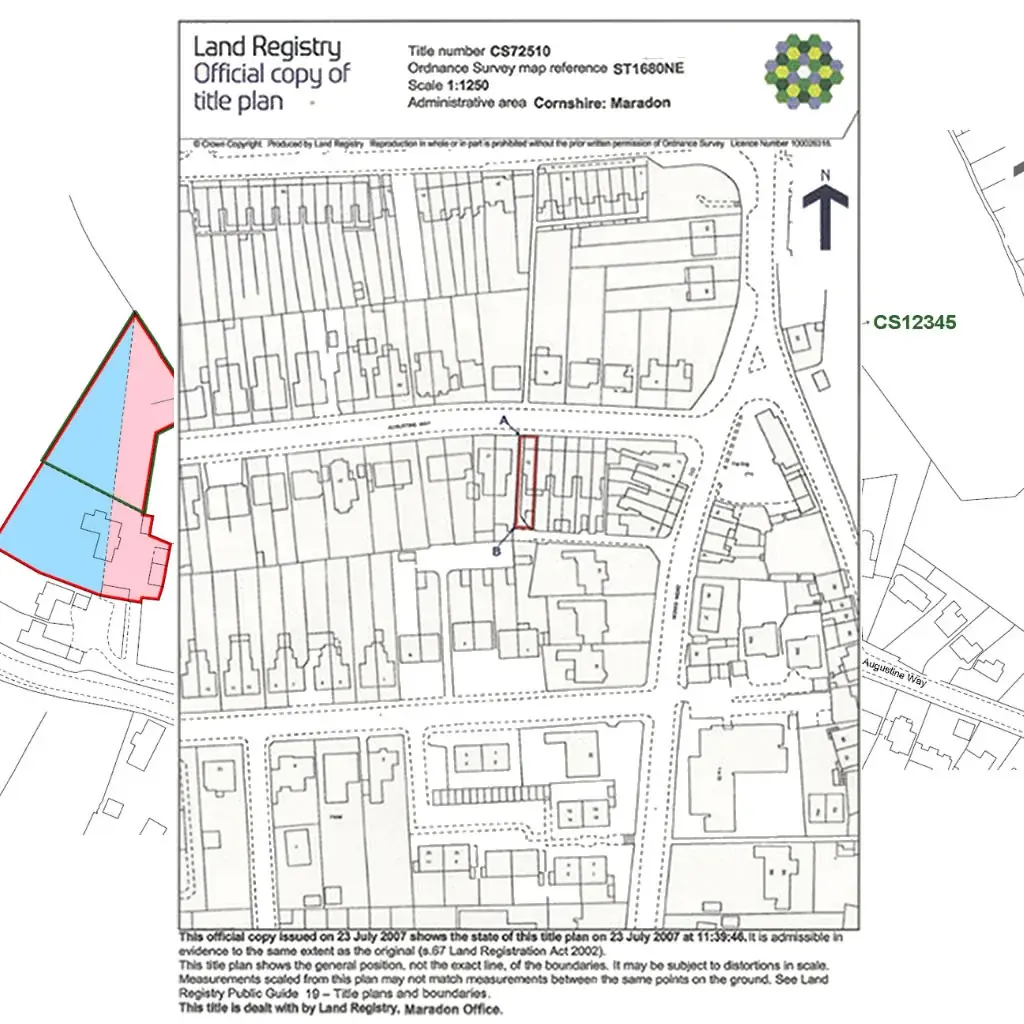
Order the Official Title Plan & Title Register — may reveal fence covenants, T-marks & fence rules — from £14.95, instant PDF.
HMLR documents may reveal fence covenants, T-marks & Fence responsibilities.
Enter Your Postcode →
Review HMLR Historical Documents
Still unclear? If available, order the historical Transfer deed (TP1/TR1) or Conveyance — may hold the fencing covenants — £18.95, instant PDF.
Best chance of finding the original T-mark and covenant wording for post-1990 estates.
Enter Your Postcode →
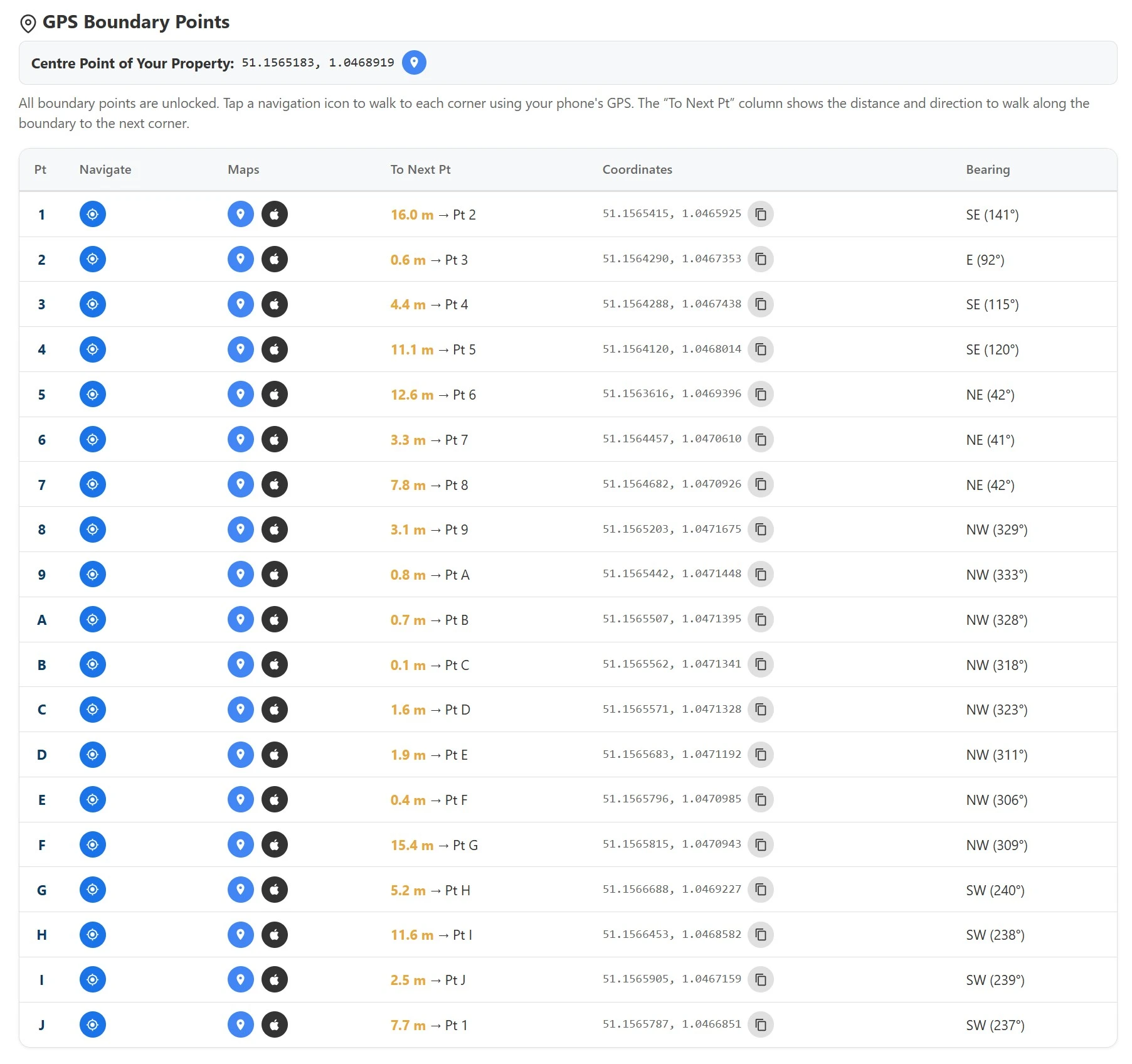
Order Your GPS Boundary Report
Knowing your boundary fence lines is essential to any fence issue — GPS coordinates for every corner — £24.95, instant PDF.
Confirm your general boundary, then search HMLR documents for fencing covenants & T-Marks.
Enter Your Postcode →HMLR Documents — T-Marks & Covenants Explained.
A T-mark paired with the deed’s covenant wording is the definitive answer to fence maintenance responsibility — but that combination is absent from the vast majority of current title plans. This is a systemic problem affecting millions of properties, not a gap in your specific title. For post-1990 estates, historic filed documents such as Transfer deeds and Conveyances — which we retrieve for you — have a reasonable chance of holding the original T-mark plan and covenant wording. For older properties, the trail frequently goes cold.
Why T-marks are missing → Routes to try — with honest expectations →
Still No Answer? Order the Historical Transfer or Conveyance
If your current Title Plan and Register are silent on T-marks or covenant wording, the original historical Transfer deed (TP1/TR1) or Conveyance filed with HM Land Registry may still hold them — order it as a separate document. If the trail goes cold entirely, physical fencing conventions such as the hedge and ditch rule remain valid legal evidence.
Routes to try — with honest expectations → Fencing conventions guide →
Why the GPS boundary report comes first
To investigate which fence is yours, you first need to know where your general boundary runs on the ground. Without that, you can’t identify which physical features — fences, hedges, walls — sit on or near the line. The GPS report gives you that foundation: identify the features along the boundary, then investigate ownership of each one using HMLR title documents and fencing conventions.
Why Doesn’t My Title Plan Show Who Owns the Fence?
Most homeowners who check their title plan find no T-marks at all. This is not a gap in your specific title — it is a systemic problem affecting millions of properties across England and Wales.
T-marks identifying fence maintenance covenants were recorded in original conveyance deeds when plots were first sold, typically in the 1960s–1980s. When those properties were later registered at HM Land Registry, the T-mark information was only transferred into the title register if the solicitor specifically requested it. In practice, this step was routinely omitted.
The result: the T-marks exist in the original paper deed, but never made it into the registered title. For properties registered before compulsory first registration became universal across the whole of England and Wales in 1990, this gap is especially common. Millions of properties are registered with a title plan that shows no T-marks, even though the original conveyance plan contained them.
This is not a Land Registry error. It is a consequence of how the 1925 registration system operated in practice for over 65 years — and the gap is, for most properties, permanent. Investigating the filed documents is worth trying, but frequently returns nothing for pre-1990 estates.
Read the full history: Why T-mark records were lost →Free Fence & Boundary Guides
Everything you need to understand fence ownership and boundary law in England & Wales — no account required.
General Boundaries Rule
Land Registry title plans show a general boundary, not the exact line. Understand what this means for your fence and why the red edging cannot alone resolve a dispute.
Read the guide ›Fence Ownership Guide
T-marks, H-marks, the left-fence myth, and what happens when the title plan is silent. The complete legal guide to who owns and must maintain a boundary fence.
Read the guide ›Fence Disputes Guide
97% of fence disputes are resolved without court. Step-by-step from direct conversation to mediation to the First-tier Tribunal — plus where to get professional help.
Read the guide ›Fencing Conventions
Post orientation, closeboard face direction, wall face rules and the hedge and ditch rule — how the physical build of a fence indicates ownership when documents are silent.
Read the guide ›Where Are My T-Marks?
T-marks are absent from the vast majority of current title plans. Learn what routes to try, what to realistically expect from each — and what it means when the trail goes cold.
Read the guide ›Party Wall Act 1996
Planning work near a shared wall or the boundary? Understand when the Party Wall Act applies, what notices you must serve, and what happens if you don’t.
Read the guide ›Your GPS Boundary Report
Instant PDF delivered to your email. Built from the official HM Land Registry INSPIRE Index Polygons — general boundaries under Section 60, Land Registration Act 2002.
- GPS coordinates for every boundary corner (lat/lng + British National Grid)
- Satellite boundary map with registered boundary overlay
- QR code navigation — walk to each corner with your smartphone
- Total land area in m² and hectares
- Full boundary perimeter measurement
- Elevation profile from EA LiDAR data (75% England coverage)
- Building footprint and site coverage percentage
- UK Fence & Boundary Ownership Guide PDF — T-marks, common law presumptions, how to find your Parent Title, physical inspection checklist & more (10 sections, included free)
£24.95 — instant PDF delivery
Ready in under 3 minutes
Enter your postcode
Type your postcode in the search bar above.
Select your property
Pick your address from the interactive map.
Pay securely
Stripe checkout — card, Apple Pay or Google Pay.
Instant PDF by email
Your report arrives in your inbox immediately.
Fence Ownership FAQ
Which fence you're responsible for is set out in the covenant wording of your title deeds, not by left or right position. Where a T-mark appears on the HMLR Title Plan it identifies which boundary that covenant applies to, sitting inside the boundary of the responsible owner. If no T-marks or covenant wording are present, apply physical fencing conventions and the hedge and ditch rule.
There is no left-fence or right-fence rule in English law. The belief that you own the left fence is a myth with no legal basis. Fence responsibility is set by covenants in the Title Register, with T-marks in the Title Plan identifying which boundary each covenant applies to — not by position.
Order an Official Copy of the Title Plan and Title Register from HM Land Registry. Look for fence maintenance covenants in the register — these create the legal obligation — and any T-marks on the plan identifying which boundary they apply to. Then use a BoundaryFinder GPS Boundary Report to see the general boundary position on the ground.
Fence maintenance responsibility in England and Wales is set by the covenant wording in the Title Register and original conveyance deed held at HM Land Registry. Where a T-mark appears on the Title Plan, it identifies the boundary that covenant applies to. Where no covenant or T-mark exists, responsibility falls back on common law presumptions such as the hedge and ditch rule.
Fence ownership means the legal obligation to maintain and repair the fence so it does not fall into disrepair. This obligation is created by covenant wording in the HMLR Title Register or the original conveyance deed; a T-mark on the Title Plan simply identifies which boundary that covenant applies to. Failing to maintain an owned fence can result in a neighbour seeking damages or a court order for repair.
HM Land Registry records fence maintenance obligations through covenant wording in the Title Register, with T-marks on the Title Plan identifying which boundary each obligation applies to. Where no T-mark exists, responsibility falls back on the original conveyance deed or common law presumptions.
A T-mark on an HMLR Title Plan indicates maintenance responsibility for a boundary fence. The cross-bar sits on the boundary line; the foot points into the land of the responsible owner. T-marks only have legal effect if the original conveyance deed expressly referred to them.
There is no automatic rule in English or Welsh law about which side of a fence you own. Maintenance responsibility is set by covenant wording in the Title Register, with T-marks on the Title Plan (where present) identifying which boundary each covenant applies to. If both documents are silent, physical fencing conventions and the hedge and ditch rule may indicate responsibility.
Order Your GPS Boundary Report
Check Your Official HMLR Documents
Review HMLR Historical Documents
Sample Boundary Report

GPS Boundary Report