Find a Boundary Surveyor
RICS-Qualified Experts for Fence & Boundary Disputes — England & Wales
If a boundary or fence dispute cannot be resolved by talking to your neighbour, a RICS-qualified boundary surveyor can provide a professional opinion, prepare expert evidence, and help you understand your legal position — before matters escalate to tribunal or court.
1. Talk to Your Neighbour First

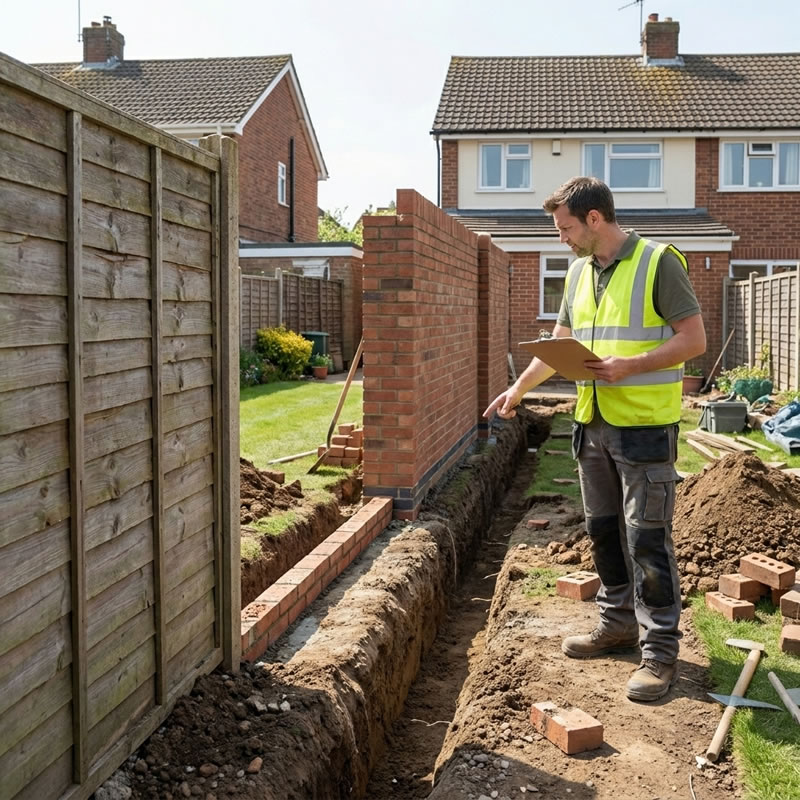
A typical party boundary between two properties — the starting point for most neighbour disputes over fences and land.
Most boundary and fence disputes can be resolved without professional fees. Before spending £800–£4,000 on a surveyor, try these steps:
- Understand general boundaries — under Section 60 of the Land Registration Act 2002, all registered title plans show a general boundary only, not the exact legal line. Your neighbour may not realise this either — sharing this information often defuses disputes instantly.
- Check your title documents — look at your title register and title plan from HM Land Registry (available for £3 at gov.uk). Check for T-marks indicating who owns which fence.
- Walk the boundary together — compare the title plan against features on the ground. Many disputes are based on misunderstanding of where the boundary sits.
- Write a friendly letter — put your understanding in writing calmly. This creates a record and often prompts a constructive response.
Instructing a surveyor without first attempting dialogue often escalates a dispute that could have been resolved amicably. Courts and tribunals expect parties to have attempted resolution before formal proceedings — evidence of good-faith attempts to negotiate is viewed favourably.
If direct communication has failed, or if the dispute involves a significant area of land, a legal threat, or damage to property, then professional advice is the right next step.
2. When You Need a Professional Surveyor
Certain situations clearly warrant professional involvement from the outset:
If your neighbour has instructed a solicitor or threatened legal action, instruct a surveyor immediately to establish your position before any correspondence.
If you intend to build near a boundary — wall, extension, outbuilding — a surveyor can confirm the exact position before work begins and prevent a costly dispute mid-build.
Courts have confirmed that general boundary uncertainty can affect large areas. If more than a strip of land is in question, professional evidence is essential.
An unresolved boundary dispute must be disclosed to buyers. Resolving it with a formal boundary agreement or determined boundary application before sale protects the transaction.
Encroaching tree roots, overhanging branches, or structures built across a boundary require precise survey evidence to support any legal remedy.
Applying to HMLR to fix the exact boundary line (Form DB) under Section 60(3) LRA 2002 requires a surveyor-prepared plan to a high standard of accuracy.
3. What a Boundary Surveyor Does

A boundary surveyor physically inspects the site, measures features against title documents, and forms an expert professional opinion on the boundary position.
A boundary surveyor provides a professional service that goes far beyond what any map or title plan can show on its own. Their work typically involves:
Physical Site Survey
The surveyor visits the property and neighbouring land to physically measure the positions of existing features — fences, walls, hedges, ditches, and other boundary markers — using precision instruments (see Section 6). These measurements are tied to the OS National Grid so they can be directly compared with title plan data.
Historical Deed and Document Research
Most boundary disputes turn on what the original conveyance documents intended. The surveyor researches:
- The original conveyance or transfer deed (which created the separate titles)
- Attached plans — scale, orientation, and draughting conventions
- T-marks, H-marks, and other boundary ownership symbols
- Historical OS maps, tithe maps, estate plans, and aerial photographs
- Planning records showing original plot layouts
Expert Professional Opinion
Drawing on the physical survey and documentary research, the surveyor forms an expert opinion on where the boundary was intended to be and where it currently sits on the ground. This opinion is recorded in a formal written report.
Written Expert Report
For dispute cases, the surveyor produces a formal expert report compliant with Part 35 of the Civil Procedure Rules (CPR). This report can be submitted as evidence in mediation, the RICS Boundary Disputes Mediation Service (BDMS), the First-tier Tribunal (Property Chamber), the Upper Tribunal, or the County Court.
4. RICS Qualifications Explained

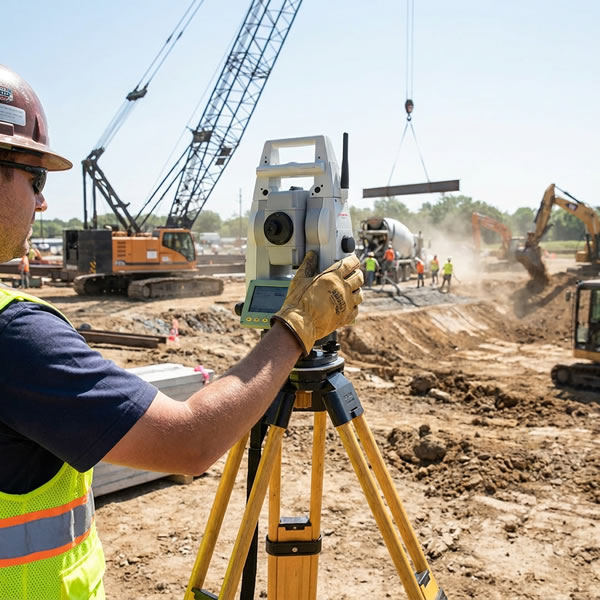
A theodolite on a tripod — traditional precision survey equipment used by chartered surveyors for boundary determination work.
When instructing a surveyor for a boundary matter, qualifications matter significantly. The recognised standards are:
| Designation | Full Title | What It Means |
|---|---|---|
| MRICS | Member of the Royal Institution of Chartered Surveyors | Has passed the RICS Assessment of Professional Competence (APC). Qualified to practice independently. This is the standard minimum for boundary survey work. |
| FRICS | Fellow of the Royal Institution of Chartered Surveyors | Senior designation — awarded for significant contribution to the profession. Indicates extensive experience. Many expert witnesses hold FRICS. |
| AssocRICS | Associate Member | Entry-level qualification. Suitable for standard surveys but not for complex boundary disputes requiring expert witness work. |
Specific Boundary Dispute Experience
Beyond the core RICS designation, look for surveyors who:
- Have specific experience in boundary identification and expert witness work
- Are familiar with Part 35 CPR requirements for expert reports
- Have experience of First-tier Tribunal (Property Chamber) proceedings
- Are listed on the RICS Boundary Disputes Panel (where applicable)
- Have experience of the RICS Boundary Disputes Mediation Service (BDMS)
Always ask a prospective surveyor: "Have you prepared Part 35 expert reports for boundary disputes?" and "Have you given evidence at the First-tier Tribunal?" — the answers tell you whether they have the specific experience your case may need.
5. Can a Surveyor Represent You in Court or Tribunal?
This is one of the most common questions — and the distinction matters:
- Act as an expert witness — providing an independent professional opinion on the boundary position to the tribunal or court
- Prepare and submit a Part 35 CPR expert report as evidence
- Attend the First-tier Tribunal (Property Chamber) to give oral expert evidence and be cross-examined
- Act as a jointly appointed expert — a single surveyor instructed by both parties to provide an independent report (often the most cost-effective route)
- Act as a party-appointed expert — instructed by one party, while owing their duty to the court
- Prepare a Scott Schedule setting out areas of agreement and disagreement with the opposing expert
- Act as your legal advocate — arguing your case, making legal submissions, or cross-examining witnesses on your behalf
- Provide legal advice on your rights or remedies — that requires a solicitor
- Make tactical decisions about the litigation — costs, settlement strategy, witness evidence
Who Represents You at Tribunal?
At the First-tier Tribunal (Property Chamber) — the most common forum for boundary disputes in England and Wales — you have several options:
- Represent yourself (as a litigant in person) — permitted and common for straightforward cases
- Instruct a solicitor — recommended where the case is complex or significant sums are at stake
- Instruct a barrister directly (via direct access) — cost-effective for the hearing itself
The surveyor sits alongside your legal representative and gives expert evidence when called — they are not your advocate.
Before tribunal, consider the RICS BDMS — a formal mediation service where a neutral RICS-accredited mediator helps both parties reach a voluntary agreement. Much faster and cheaper than tribunal. No binding outcome unless both parties agree. Search for BDMS mediators at ricsfirms.com.
6. Survey Tools & Technology

A GNSS RTK receiver ties boundary measurements to the OS National Grid with centimetre accuracy — the same technology used in professional boundary surveys.
Professional boundary surveyors use precision instruments to tie measurements to the Ordnance Survey National Grid (OSGB36) — so their survey coordinates can be directly compared with title plan data, historical maps, and OS base mapping.
Total Station (Theodolite + EDM)
The traditional instrument of choice for boundary surveys. A total station measures horizontal and vertical angles and distances from a fixed known point, producing highly accurate XYZ coordinates of every measured feature. It works in any weather, does not depend on satellite signals, and is the standard instrument for legally submitted survey evidence.
GNSS RTK Receivers
GNSS RTK (Real-Time Kinematic) receivers use satellite signals corrected in real time by a reference station network (such as Ordnance Survey's OS Net) to achieve centimetre-level accuracy in the field. RTK is faster than total station work for open-air surveys and is increasingly used alongside traditional methods.
BoundaryFinder's GPS Boundary Report exports your registered boundary polygon vertices in both WGS84 lat/lng and British National Grid (BNG) easting/northing format — the exact coordinate formats used by professional surveyors. A surveyor can import these directly into their survey software as a reference baseline before visiting site.
From the property search page, you can export your boundary polygon as a GPX file compatible with GNSS devices. Your GPS Boundary Report includes the registered boundary position in BNG easting/northing — coordinates any RICS surveyor will immediately recognise. This can save time at the initial consultation stage. Learn about GNSS receivers used for boundary surveys →
7. Typical Costs
Surveyor fees vary considerably by location, complexity, and the amount of historical research required. The figures below are indicative for England and Wales in 2025–2026:
| Service | Typical Cost Range | Notes |
|---|---|---|
| Initial site visit & verbal opinion | £300–£600 | Useful to establish whether a case exists before committing to a full report |
| Boundary survey & written report | £800–£2,500 | Depends on complexity, size, and amount of historical deed research |
| Part 35 CPR expert witness report | £1,500–£4,000 | Formal report for tribunal or court proceedings; includes legal declarations |
| Joint expert report (shared by both parties) | £1,000–£2,500 (shared) | Often ordered by the tribunal — each party pays half. Most cost-effective route. |
| Attendance at tribunal hearing | £800–£2,000 (per day) | Day rate for giving oral evidence; complex cases may require multiple days |
| Determined boundary plan (Form DB) | £600–£1,500 | Surveyor-prepared plan required for HMLR Form DB application under S.60(3) LRA 2002 |
Fees vary significantly between firms. Always obtain at least two quotes and ask for a clear breakdown of what is included. Clarify whether the quoted fee covers a single site visit, the full written report, and whether it is fixed or time-and-materials.
Keeping Costs Down
- Prepare your own documentation before the first consultation — title register, title plan, deed plan, any previous correspondence
- Prepare a clear timeline of events and a sketch of the disputed area
- Consider the RICS BDMS mediation route before instructing separate surveyors — if successful, it costs a fraction of tribunal fees
- Ask whether a jointly appointed expert (rather than party-appointed experts on both sides) is appropriate — it halves the expert evidence cost
- Use your BoundaryFinder GPS report to give the surveyor the registered boundary coordinates before their site visit — this can reduce initial research time
8. Find a RICS Boundary Surveyor Near You
The RICS Firm Finder at ricsfirms.com lets you search for chartered surveying firms by postcode and service type. Enter your postcode below and we'll open the RICS search filtered to boundary dispute specialists:
Or search directly at ricsfirms.com — enter your postcode and select "Land and boundary disputes" under service category.
What to Look For in the Search Results
- Designation: MRICS or FRICS (not just AssocRICS for dispute work)
- Service listed: Land and boundary disputes or Expert witness
- Regulated by RICS (shown as a badge on the firm listing)
- Professional Indemnity Insurance — ask the firm directly if not shown
For disputes where both parties are willing to engage, the RICS BDMS provides a structured mediation route. A neutral RICS-accredited mediator facilitates a without-prejudice session. If agreement is reached, it can be recorded as a formal boundary agreement lodged with HMLR. Search for BDMS mediators at ricsfirms.com.
A party boundary between two residential properties

A RICS chartered surveyor conducting a boundary inspection at a residential property
GNSS RTK receiver being used in the field for boundary survey

Surveyor's theodolite on a tripod used for boundary measurements