
Fence Dispute With a Neighbour?
Fence or boundary dispute? Start with the evidence: know where your registered boundary sits, then check your HMLR documents for T-marks and fence covenants.
GPS Boundary Report — £24.95
How to Resolve a Fence Dispute: Gather the Evidence First
In a fence dispute, proof comes before conversation. Work through these three steps — you may not need all of them.
Under Section 60 of the Land Registration Act 2002, almost all registered property boundaries in England & Wales are general boundaries — not a fixed legal line. We help you locate and walk yours.
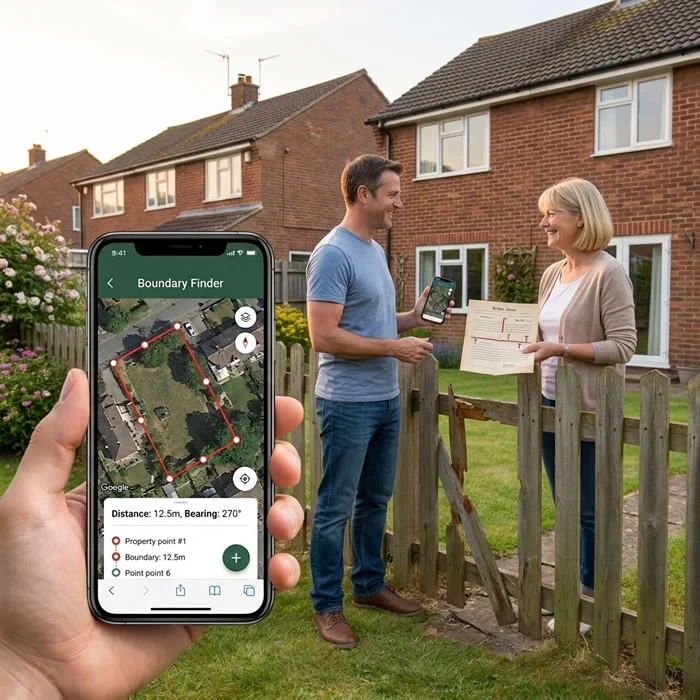
Step 1: Check Where Your Registered Boundary Sits
Order a GPS Boundary Report to see your registered general boundary position against the fence, with GPS coordinates for every corner. It is supporting evidence for a fence dispute, not a legal determination — £24.95, instant PDF.
Enter Your Postcode →
Step 2: Check the Title Register & Title Plan for Fence Covenants
The Title Register may hold the fence covenant wording and the Title Plan may show T-marks. A T-mark shows which boundary a covenant applies to, and the deed wording creates the obligation to maintain — from £14.95, instant PDF.
Enter Your Postcode →
Step 3: Order the Original Transfer or Conveyance Deed
If the current documents are silent, order the original transfer deed (TP1/TR1) or conveyance, which may hold the fencing covenants and the original T-mark plan, especially for post-1990 estates — £18.95, instant PDF.
Enter Your Postcode →What Evidence Helps in a Fence Dispute With a Neighbour?
Evidence can show a neighbour, mediator or surveyor where the registered general boundary sits and what your deeds say about the fence. It cannot determine the legal boundary, and responsibility to maintain a fence is not the same as owning it.
Alongside the documents, gather the physical evidence. Photograph post positions, which way the closeboard faces, and any hedge or ditch, ideally dated and from both sides. Where the documents are silent, fencing conventions such as the hedge and ditch rule are recognised evidence.
Fencing conventions guide → Where are my T-marks? → What is a general boundary? →
Neighbour Built a Fence on My Land?
If a neighbour has put up a fence that you believe sits on your land or property, establish where your registered boundary runs before you speak to them.
1. Check where the fence sits. Compare the fence with your registered general boundary position. The boundary on a title plan is general, not the exact legal line, so a fence a little off the plan line is not automatically on your land. A fence clearly beyond it is worth pursuing. Take dated photos of the fence from both sides.
2. Check the documents. Your Title Plan and Register, and your neighbour’s, show the registered extent of each property. The historic Transfer or Conveyance may show where the boundary was originally laid out, and any T-mark or covenant about the fence.
3. Raise it calmly with your neighbour. Share your evidence and ask them to look at it with you. Avoid removing or damaging the fence yourself, as that can turn a boundary question into a dispute over damage. If you can’t agree, try mediation, or ask a chartered surveyor to assess the evidence.
Get your GPS Boundary Report → Order HMLR documents → Where are my T-marks? →
Boundary Dispute With a Neighbour? Not Just Fences
A boundary dispute can involve a fence, hedge, wall or the line itself. The evidence you need is the same: where the registered boundary sits, and what the deeds say.
Fences, hedges, walls and the line. The feature on the ground is not always on the registered boundary, and the boundary on a title plan is a general boundary, not the exact legal line. Where documents are silent, conventions such as the hedge and ditch rule are recognised evidence of where the boundary lies.
Start with the registered boundary. Order your GPS Boundary Report to see the registered general boundary position on a satellite map, then your HMLR Title Plan and Register for the registered extent and any covenants. The historic Transfer or Conveyance may show how the boundary was first laid out.
If you can’t agree. Share your evidence with your neighbour and try mediation first. A chartered surveyor can assess a genuinely uncertain boundary, and a determined boundary can be applied for to HM Land Registry (Form DB).
Get your GPS Boundary Report → Order HMLR documents → Fencing conventions guide →
Fence Dispute Evidence FAQ
A boundary dispute is a disagreement about where the line between two properties runs, or who is responsible for a fence, hedge or wall on it. The registered boundary is usually a general boundary, so the line on the title plan is approximate and evidence of the true position often comes from the deeds and physical features.
Start by gathering evidence: the registered general boundary position, the Title Plan and Register, any historic Transfer or Conveyance, and photographs of the physical boundary. Share it with your neighbour and try to agree. If you can’t, consider mediation or a chartered surveyor before formal action. This is general information, not legal advice.
First check where your registered general boundary sits and where the fence stands, then look at your Title Plan, Register and any historic deeds. Share that evidence with your neighbour and try to agree a solution. If you can’t, consider mediation or a chartered surveyor before any formal action. This is general information, not legal advice.
Plot your registered general boundary on a satellite map and compare it with the fence, using GPS coordinates for each corner. Because the registered boundary is approximate, a small difference does not prove the fence is on your land. Larger differences are worth investigating with your title documents and, if needed, a surveyor.
It is best not to. If the boundary turns out to be where your neighbour says, removing it could leave you open to a claim for damage. Gather your evidence, talk to your neighbour and take advice from a solicitor or chartered surveyor before acting.
Start by knowing where your registered general boundary sits. Then look at the HM Land Registry Title Plan and Title Register for T-marks and fence covenant wording. If they are silent, order the historic Transfer or Conveyance. Finally, photograph the physical fence, posts and any hedge or ditch.
Not on its own. A T-mark usually indicates the side with a covenant to maintain the boundary feature. The covenant wording in the deed creates the obligation, and responsibility to maintain is not the same as ownership.
No. It shows the approximate registered general boundary position from HM Land Registry INSPIRE data, which is useful supporting evidence. It does not determine the legal boundary. A determined boundary needs an application to HM Land Registry, and a chartered surveyor can advise on the evidence.
This is common, especially for older estates. The original Transfer or Conveyance may still hold the T-mark plan and covenant wording. If not, physical evidence and common law presumptions such as the hedge and ditch rule may help.
Not necessarily. The title plan shows a general boundary, not the exact legal line, so a fence a little off the plan line does not by itself mean it is on the wrong land. Where the position is genuinely uncertain, a chartered surveyor can assess the evidence, and mediation is usually cheaper than court.
Related Fence Guides
Fence Disputes Guide
Step-by-step from direct conversation to mediation to the First-tier Tribunal, plus where to get professional help.
Read the guide ›Which Fence Is Mine?
Fence ownership and maintenance responsibility, T-marks and covenant wording explained.
Read the guide ›General Boundaries Rule
What the red line on a title plan means, and why it cannot alone resolve a dispute.
Read the guide ›Fence Ownership Guide
T-marks, H-marks, the left-fence myth, and what happens when the title plan is silent. Who owns and must maintain a boundary fence.
Read the guide ›Fencing Conventions
Post orientation, closeboard face direction and the hedge and ditch rule: how the build of a fence can indicate ownership when documents are silent.
Read the guide ›Where Are My T-Marks?
T-marks are absent from most current title plans. What routes to try, what to expect from each, and what it means when the trail goes cold.
Read the guide ›The T-Mark Fence Ownership Problem
Why so many title plans show no T-marks, how the 1925 Act and compulsory registration created the gap, and what to try next.
Read the guide ›Official HMLR Title Plan & Register
Order the official Title Plan, Title Register and historic title deeds to check for fence covenants and T-marks, delivered as PDFs by email within minutes.
See the documents ›Adverse Possession & Boundary Encroachment
Neighbour’s fence, garage or extension crossing your registered land? Learn how adverse possession works in England & Wales and what a Boundary Encroachment Notice is.
Read the guide ›